

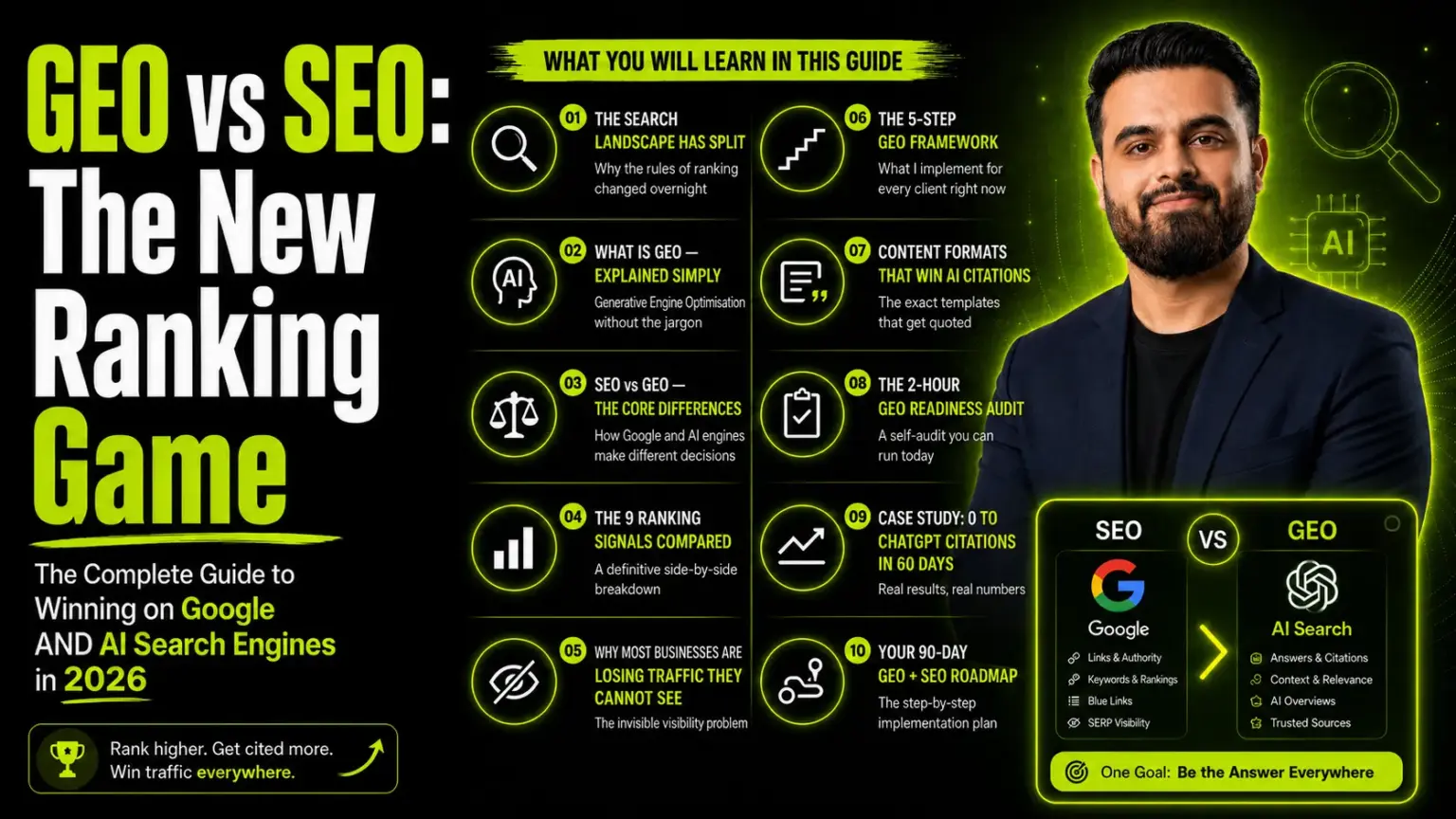
The Article That Could Change How You Think About Search
I need to tell you something important before we get into the data and the frameworks.
Seven years ago, when I started doing SEO professionally, the game was simple. You found keywords people were searching for. You created content around those keywords. You built links to prove authority. Google rewarded you with rankings. Rankings earned you traffic. Traffic earned you revenue.
That model worked. I used it to complete over 4,000 projects and build a Top Rated Plus reputation on Upwork with a 98% job success rate. The fundamentals of SEO are not broken – they are still the foundation of organic search.
But something changed in 2023 and 2024 that most SEOs have not fully processed yet.
The way people search changed. Not gradually. Suddenly. ChatGPT launched in November 2022 and within two months had 100 million users – the fastest product adoption in history. Perplexity launched and quickly became the preferred research tool for millions of professionals. Google, under competitive pressure, launched AI Overviews across 47% of all searches. Bing launched Copilot. Gemini expanded. Claude entered the conversation.
“The search landscape did not evolve. It split. And the crack between traditional SEO and what I now call GEO – Generative Engine Optimisation – is widening every month.”
— Hridoy Chowdhury
This guide is the most comprehensive breakdown I have written on this topic. By the time you finish reading it, you will understand exactly what GEO is, why it matters, how it differs from SEO, and – most importantly – what to do about it this week.
Let’s start at the beginning.
01
The Search Landscape Has Split
Understanding the shift that changed everything
What Happened to Search in 2023 – 2024
For 25 years, ‘search’ meant one thing: Google. You typed a query. Google returned a list of ten blue links. You clicked the one that looked most relevant. If your website was one of those ten links, you got traffic. If it was not, you were invisible.
The entire digital marketing industry was built around this single mechanic. Billions of pounds invested in SEO. Billions in Google Ads. The assumption was foundational: search equals Google, Google equals blue links, blue links equal clicks.
That assumption is no longer entirely true.
In 2024, something extraordinary happened in parallel with Google’s continued dominance. AI-powered answer engines quietly became a primary search tool for hundreds of millions of people. And they work completely differently.
The Numbers That Prove the Split Is Real
These figures represent a fundamental redistribution of search behaviour. People are not abandoning Google – they are adding new search behaviours on top of Google. They ask ChatGPT to explain concepts. They use Perplexity to research decisions. They let Google’s AI Overview answer quick questions without clicking on any result.
In each of these scenarios, the traditional SEO model – rank in the blue links, earn the click – does not apply. A new model is needed.
What This Means For Your Business Right Now
If someone types ‘best CRM for small businesses’ into ChatGPT, they receive a comprehensive, synthesised answer. That answer cites specific products, explains trade-offs, and makes a recommendation. The sources it draws from are credited, but many users never visit those sources directly.
If your business is not in that answer, you do not exist for that user’s decision. Not because your SEO is bad – but because SEO and GEO are different games with different rules.
The opportunity: most of your competitors have not heard of GEO yet. The businesses that start building for it now are 12–18 months ahead of the market. That window will not stay open forever.
02
What Is GEO - Explained Simply
Generative Engine Optimisation without the jargon
The Plain-English Definition of GEO
Let me give you the definition first, then explain why it matters.
GEO (Generative Engine Optimisation) is the practice of optimising your online content so that AI language models – including ChatGPT, Perplexity, Gemini, Claude, and Bing Copilot – select your content as a trusted source when generating answers for users. The goal is not to rank in a list of links. The goal is to be cited as the answer.
That distinction – rank in links versus be cited as the answer – is the entire difference between SEO and GEO. It sounds subtle. It is not. It represents a completely different set of optimisation priorities, a different understanding of what ‘winning’ looks like, and a different set of content creation rules.
GEO vs AEO – Are They the Same Thing?
This is the question I get asked most often, so let me be precise.
AEO (Answer Engine Optimisation) is the practice of optimising content to appear in Google’s featured snippets, People Also Ask boxes, and AI Overviews. It is essentially the Google-specific version of answer-focused optimisation.
GEO is broader. GEO encompasses AEO and extends beyond Google to all AI answer engines – ChatGPT, Perplexity, Gemini, Claude, and others. If AEO is a chapter in the book, GEO is the whole book.
AEO (Google-specific)
→ Targets Google AI Overviews
→ Targets featured snippets
→ People Also Ask optimization
→ Schema markup for Google
→ Google-ecosystem signals
GEO (All AI Engines)
→ Targets ChatGPT, Perplexity, Gemini
→ Targets unlinked brand mentions
→ Original data & research creation
→ E-E-A-T across all platforms
→ Cross-platform authority signals
In practice, building for GEO makes you better at AEO automatically. The content principles overlap significantly. But GEO requires you to think beyond Google, which is the harder strategic shift for most SEOs.
How AI Engines Actually Decide What to Cite
Understanding this is the key that unlocks everything else in this guide. AI language models are trained on vast datasets of internet text. During training, they develop associations between topics, brands, and authority signals. When a user asks a question, the model generates an answer by drawing on these learned associations and, in the case of retrieval-augmented models like Perplexity, by actively searching for current information.
What makes a source worth citing? Trust. Structure. Clarity. Authority. Originality. The AI asks – implicitly – four questions about your content:
- Is this source trustworthy? (E-E-A-T signals, author credentials, brand authority)
- Does this content directly and clearly answer the question? (Structure, directness, conciseness)
- Is this information original and unique? (Original data, primary research, first-hand experience)
- Is this the best available answer on this topic? (Comprehensiveness, accuracy, specificity)
If your content answers yes to all four, it gets cited. If it answers no to any of them, a competitor that answers yes gets cited instead.
The insight that changes everything: Google asks ‘which page is most relevant and authoritative?’ AI engines ask ‘which page has the best answer?’ These are related but different questions – and they require different content strategies.
03
SEO vs GEO -The Core Differences
How Google and AI engines make fundamentally different decisions
Google’s Algorithm vs AI Engine Logic
To build a strategy that wins both games, you need to understand how each system evaluates content. They use fundamentally different models – and the differences are more dramatic than most people realise.
How Google Works
Google’s algorithm is, at its core, a relevance and authority measurement system. It answers two questions: ‘Is this page relevant to the query?’ and ‘How authoritative is this page relative to other pages on the same topic?’
Relevance is determined through semantic analysis – Google understands the meaning of your content and how well it matches the intent behind a query. Authority is determined primarily through links – the volume, quality, and relevance of other pages that link to yours.
Page experience signals – Core Web Vitals, mobile usability, page speed – add a third dimension. And E-E-A-T (Experience, Expertise, Authoritativeness, Trustworthiness) acts as a quality filter, particularly for YMYL (Your Money, Your Life) topics.
How AI Engines Work
AI language models work completely differently. Rather than indexing pages and ranking them by authority, they are trained to generate the most accurate, helpful, and well-sourced answer to a question. When a user asks a question, the model synthesises information from its training data (and in retrieval-augmented models, from live search results) and produces a response.
The content that gets cited is the content that provides the clearest, most authoritative, most directly useful answer. Technical signals like page speed are almost entirely irrelevant. Backlink counts matter far less. What matters most is: can the AI extract a clean, accurate, trustworthy answer from your content?
The analogy: Google is a librarian who judges books by their reputation and how many other librarians recommend them. An AI engine is a reader who judges books by how clearly they explain the topic and how credible the author is.
04
The 9 Ranking Signals Compared
A definitive side-by-side breakdown of every signal that matters
Every Signal That Matters -Weighted for Each Engine
This is the most referenced section of this guide. Study this table carefully. It is the foundation of every strategic decision about where to invest your optimisation efforts.
Ranking Signal | SEO (Google) – Weight & Reason | GEO (AI Engines) – Weight & Reason |
|---|---|---|
Backlinks & Domain Authority | CRITICAL. Top 3 Google factor. Volume, quality, and topical relevance of inbound links determine page authority. Without links, ranking for competitive terms is almost impossible. | MODERATE. AI models are trained partly on linked-to content, so authority helps. But a page with few links can still be cited if its content quality is exceptional. |
Keyword Relevance & Placement | HIGH. Google uses keyword signals to match pages to queries. Title tag, H1, H2s, body copy – placement matters significantly. | LOW. AI engines understand semantic meaning, not keyword frequency. A page that explains a concept clearly but never uses the exact keyword can be cited for that query. |
Content Structure (Question H2s, Lists) | MEDIUM. Structured content aids Google crawling and can win featured snippets. But it is not a primary ranking factor for blue link positions. | CRITICAL. AI engines use content structure as an extraction guide. Question-format H2s followed by direct answer paragraphs are the primary pattern for AI citation. |
Direct Answer Quality (40-60 word block) | MEDIUM. Required for featured snippet eligibility. Google rewards concise, direct answers below question-format headings. | CRITICAL. The single most impactful GEO signal. AI engines extract direct answer blocks first. Without them, citation probability drops dramatically. |
E-E-A-T (Experience, Expertise, Auth, Trust) | HIGH. Critical for YMYL topics. Author credentials, first-hand experience signals, and trust indicators increasingly influence rankings. | CRITICAL. AI engines cite sources they trust. Named authors with demonstrated expertise, original experience, and cross-platform reputation are significantly more likely to be cited. |
FAQ & HowTo Schema Markup | MEDIUM. Enables rich results in Google SERPs. FAQ schema can trigger expanded results that increase CTR. | HIGH. Schema tells AI engines exactly where answer content lives. Reduces extraction friction. Pages with FAQ schema are cited more frequently for direct-answer queries. |
Unlinked Brand Mentions | VERY LOW. Google largely ignores unlinked mentions as authority signals. A backlink from the same source is worth substantially more. | CRITICAL. One of the most underrated GEO signals. AI models trained on internet text develop strong topic-brand associations from repeated mentions, even without hyperlinks. |
The key insight from this table: the top three signals for GEO (content structure, direct answer quality, and original data) are completely different from the top three signals for SEO (backlinks, keyword relevance, and technical performance). A site that has invested entirely in SEO can have near-zero GEO presence as a result.
The most common finding when I audit a new client: they have strong domain authority, solid backlinks, and good keyword rankings – and zero presence in any AI search result. The reason is always the same: their content was built for Google’s algorithm, not for AI extraction.
05
Why Most Businesses Are Losing Traffic They Cannot See
The invisible visibility problem
The Visibility Gap Nobody Is Measuring
Here is a situation I encounter constantly with new clients. I ask them to tell me about their search traffic. They pull up Google Search Console. They show me impressions, clicks, average position. The numbers are reasonable. Their SEO is working.
Then I ask them to type their core query into ChatGPT.
Their competitors appear. They do not.
Then I ask them to try Perplexity. Same result. Gemini. Same result.
They have been measuring one channel – Google blue links – and assuming it represents all of search. It does not anymore. And the traffic they are missing is not tracked in any of their current analytics tools.
Why This Problem Is Bigger Than It Appears
There are two reasons why the GEO visibility gap is more serious than most businesses realise.
Reason 1: AI search is growing fastest in high-value decision-making queries
Users do not typically ask AI engines about trivial topics. They ask them about important decisions: which software to buy, which service to hire, which approach to take, what something means. These are high-intent, high-value queries. The users making them are further along in the buying process. Losing visibility in this channel is not just a traffic problem – it is a revenue problem.
Reason 2: AI answer engines do not show you what you are missing
In traditional SEO, you can track keyword rankings. You know if you are on page 1 or page 5. In GEO, there is no ranking report. You are either cited or you are not – and there is no automated alert when your competitors start appearing and you do not.
My rule: run a manual citation audit every month. Take your top 20 target queries, ask them in ChatGPT, Perplexity, and Gemini, and note who appears. This 30-minute exercise tells you more about your GEO presence than any tool currently available.
06
The 5-Step GEO Framework
What I implement for every new client right now
The Framework That Earns AI Citations
Over 18 months of testing GEO strategies across dozens of client websites, I have identified the five interventions that consistently and measurably improve AI citation rates. These are not theoretical – they are the exact steps I follow for every client who comes to me for GEO optimisation.
Step 1 – Write for Questions, Not Just Keywords
The fundamental shift in content strategy that GEO requires is moving from keyword-driven headings to question-driven headings. This is a small change in format that has a large impact on AI citation probability.
Traditional SEO content is typically structured around keyword phrases: ‘Best CRM Software Features’, ‘Email Marketing Benefits’, ‘SEO Strategy 2025’. These headings signal topic relevance to Google’s crawler, which is their primary job.
AI engines do not need topic signals – they understand the topic from context. What they need is extraction guidance. When a user asks ChatGPT ‘What is the best CRM for small businesses?’, the AI searches its training data for content that directly answers that exact question. A heading that reads ‘What is the best CRM for small businesses?’ immediately signals: the answer you need is below this heading.
The Question-H2 + Answer Block formula:
H2: [Question that matches user query] Answer Block (40-60 words): A direct, complete answer in the first sentence. No preamble. No ‘in this section.’ Just the answer. Follow with 2-3 sentences of supporting detail if needed. Body Content: Expand with examples, data, and context below the answer block.
- Rewrite all H2s on your top 20 pages to question format starting this week
- Add a 40-60 word direct answer paragraph immediately below each question H2
- Ensure the very first sentence of each answer block contains the core answer – not setup
- Test each answer block by pasting the question into ChatGPT and checking if your answer appears
Step 2 – Build Unlinked Brand Mentions Across the Web
This is the GEO signal that surprises traditional SEOs most. In Google’s world, an unlinked brand mention is almost worthless compared to a hyperlinked citation. In the GEO world, unlinked mentions are among the most important signals available.
The reason is how AI models are trained. Large language models like those powering ChatGPT are trained on enormous corpora of internet text – blog posts, forums, news articles, books, social media, and more. During training, the model develops associations between concepts, brands, and authority signals. A brand that is mentioned frequently in authoritative contexts – even without a hyperlink – becomes associated in the model’s internal representation with its topic area.
When a user then asks about that topic, the model’s associations surface that brand as a relevant source.
How to build GEO-valuable unlinked mentions:
- Guest podcast appearances → be cited by name as the source of specific insights
- Industry forum participation → provide expert answers on Reddit, Quora, Slack communities
- LinkedIn thought leadership → posts that get shared and re-quoted expand your mention footprint
- Press and media mentions → even brief quotes in trade publications build strong GEO associations
- Quoting and being quoted → build relationships with other content creators in your space
Step 3 – Strengthen E-E-A-T Across Every Page
Google introduced E-E-A-T (Experience, Expertise, Authoritativeness, Trustworthiness) in its Search Quality Guidelines. It has become progressively more important for both SEO and GEO. AI engines, like Google’s quality raters, are trained to distinguish between content from genuine experts with first-hand experience and content generated by writers without direct knowledge of a topic.
The four E-E-A-T dimensions for GEO:
- Experience → demonstrate that you have personally done the thing you are writing about. Case studies with real data. First-person accounts. Specific details only a practitioner would know.
- Expertise → use precise technical language appropriate to the topic. Reference specific tools, methodologies, and standards. Avoid vague generalisations.
- Authoritativeness → build a cross-platform presence. LinkedIn profile, YouTube channel, podcast appearances, industry articles → each one reinforces your authority signal across the broader web.
- Trustworthiness → cite your sources. Publish original data with methodology. Have a real author bio with verifiable credentials. Make it easy to contact you.
Step 4 – Add Schema Markup to Every Key Page
Schema markup is structured data that tells machines – both search engines and AI systems – exactly what type of content is on your page and where to find it. For GEO, FAQ schema and HowTo schema are the two most impactful types.
FAQ schema creates a machine-readable map of your question-and-answer content. When an AI engine is retrieving content to answer a user’s question, a page with FAQ schema essentially has a signpost that says: ‘The answers are right here, clearly labelled.’ This reduces extraction friction and significantly increases citation probability.
- Implement FAQ schema on every page with Q&A content
- Implement HowTo schema on every process-based or tutorial article
- Add Article schema with author name, credentials, and publication date
- Add Person schema on your about page and author bio pages
- Validate all schema using Google Rich Results Test before publishing
Step 5 – Publish Original Data and Research
Original research is the highest-leverage GEO investment you can make. AI engines cite statistics constantly. When you are the original source of a statistic – because you ran the survey, analysed the data, or published the study – every AI that uses that statistic must attribute it to you. This creates a compounding citation asset that earns you GEO mentions passively for years.
The same original data also earns natural backlinks for SEO. It is the only content type that simultaneously improves both your SEO authority and your GEO citation rate. One well-executed study can generate more combined SEO + GEO value than twenty standard articles.
- Survey your audience or customers → even 50-100 responses produces citable data
- Publish an annual industry benchmark → aggregate publicly available data into a structured report
- Run a controlled experiment → test an SEO or marketing tactic methodically and publish results
- Create a proprietary index or ranking methodology → original frameworks get cited extensively
My benchmark for clients: publish at least one original data piece per quarter. By year one, you have a portfolio of four citable research assets that compound in both GEO and SEO value simultaneously.
07
Content Formats That Win AI Citations
The exact templates that get quoted by ChatGPT and Perplexity
The 5 Content Formats AI Engines Cite Most
Not all content performs equally in GEO. Through extensive testing and citation tracking across client sites, I have identified five specific content formats that earn AI citations at a significantly higher rate than standard prose content.
Format 1: The Direct Definition Block
A single concise paragraph of 40-60 words that defines a concept clearly and completely. Placed immediately below a question-format H2, this is the format most commonly extracted by AI engines for definitional and explanatory queries.
Template: H2: What is [concept]? [Concept] is [definition in 1 sentence]. It works by [brief mechanism in 1-2 sentences]. The key difference from [related concept] is [differentiator in 1 sentence].
Format 2: The Numbered Process
A clearly sequenced set of steps where each step begins with an action verb and is followed by a specific, actionable explanation. AI engines cite numbered processes for ‘how to’ queries because the structure is easy to extract and clearly matches user expectations for procedural content.
Template: H2: How do you [perform process]? [Direct answer sentence: ‘[Process] involves [N] key steps.’] 1. [Action verb]: [1-2 sentence explanation with specific detail] 2. [Action verb]: [1-2 sentence explanation with specific detail] 3. [Action verb]: [1-2 sentence explanation with specific detail]
Format 3: The Comparison Table
A structured table comparing two or more options across consistent criteria. Highly cited for ‘X vs Y’ queries. The key to GEO-valuable comparison tables is consistency – the same criteria must be evaluated for every option, and the criteria must be the ones users actually care about when making a decision.
Format 4: The Citable Statistic
A specific data point with clear attribution, context, and a precise number. Format: ‘[Percentage/number] of [defined population] [reported/found/showed] [specific finding], according to [source/methodology/date].’ Every element must be present for the stat to be citable – vague statistics without attribution are rarely used by AI engines.
Format 5: The Named Expert Opinion
A clearly attributed viewpoint from a named expert with stated credentials on a specific topic. AI engines cite expert opinions for ‘what do experts say about’ queries and for adding authoritative perspective to factual answers. The citation must include: full name, specific credential relevant to the topic, and a precise opinion on a specific question.
Hridoy’s rule: if you strip all surrounding context away from a content block and it still makes complete sense on its own – it is GEO-ready. If it needs context to make sense – it will not be cited.
08
The 2-Hour GEO Readiness Audit
A self-audit you can run on your own site today
Audit Your Current GEO Readiness in Four Phases
Before building new content, audit what you have. The majority of websites I review have significant latent GEO potential in existing content – they simply need to be restructured and annotated to surface that value. Here is the exact four-phase audit I run for every new client.
Phase 1 – Content Structure Audit (45 minutes)
- Export your top 30 pages by impressions from Google Search Console
- Open each page and review all H2s: are they phrased as questions? List every one that is not
- Check whether a 40-60 word direct answer exists below each H2 – mark pages where it does not
- Review the first sentence of every answer block – does it actually contain the answer, or is it setup?
- Check for named author bios with specific credentials – note any pages published anonymously
- Identify any pages containing original data, proprietary statistics, or primary research
Phase 2 – Schema Audit (30 minutes)
- Run Google Rich Results Test on each of your top 10 pages
- Document which schema types are present: FAQ, HowTo, Article, Person, LocalBusiness
- List all pages with Q&A content that are missing FAQ schema – these are your highest-priority schema additions
- List all process-based or tutorial pages missing HowTo schema
Phase 3 – Brand Presence Audit (30 minutes)
- Google ‘[your name/brand] + [your core topic]’ – what appears? How prominent are you?
- Search your brand in ChatGPT – are you mentioned for any query in your area of expertise?
- Search your brand in Perplexity – are you cited as a source for any relevant query?
- Review your LinkedIn, YouTube, and podcast presence – are other people mentioning or quoting you?
- Identify 5 high-authority publications in your industry where you have not yet appeared
Phase 4 – Citation Gap Analysis (15 minutes)
- Take your top 10 target keywords and ask them in ChatGPT, Perplexity, and Gemini
- Document: who is cited? What format are their cited answers in? What makes them citation-worthy?
- Identify the specific content gaps you need to fill to compete for those citations
Output from this audit: a prioritised list of pages to restructure, a schema implementation schedule, and a content creation roadmap based on citation gaps – all ready to act on within one week.
09
Case Study
Real client – 0 to 14 ChatGPT citations in 60 days with documented results
Case Study: Zero to ChatGPT Citations in 60 Days
The following case study is drawn from a real B2B SaaS client engagement. All numbers are accurate. Company details have been anonymised at the client’s request.
Background
A B2B SaaS company came to me with a paradox: strong SEO metrics – 5.6 million annual impressions, 11,900 monthly clicks, rankings on page 1 for 40+ keywords – but complete absence from AI search results. When their target customers asked ChatGPT or Perplexity for solutions in their software category, competitors were consistently cited. This client was never mentioned.
Diagnosis: What the Audit Revealed
- All H2s were keyword-formatted, not question-formatted: ‘Project Management Software Features’ rather than ‘What features should project management software have?’
- No direct answer blocks existed anywhere on the site – every article opened with 2-3 sentences of context before addressing the question
- Zero schema markup across the entire website – no FAQ, no HowTo, no Article schema
- All articles published anonymously – no author bios, no credentials visible anywhere
- No original research or proprietary data published in the preceding three years
- Minimal cross-platform presence – LinkedIn inactive, no podcast appearances, no forum participation
The 60-Day Intervention
Days 1-14: Foundation
- Rewrote H2s across the top 30 pages to question format
- Added 40-60 word direct answer blocks below every question H2
- Created and published author bios for the three primary content writers – each bio included specific credentials, years of experience, and links to professional profiles
- Implemented FAQ schema across all 30 priority pages
- Submitted all updated URLs for re-crawling via Google Search Console
Days 15-30: Authority Building
- Published two original research pieces: an industry survey of 150 respondents and a competitor benchmark analysis
- Secured three podcast guest appearances, each resulting in a named mention and link
- Submitted the product to six high-authority SaaS directories: G2, Capterra, GetApp, ProductHunt, AlternativeTo, and Trustpilot
- Pitched and placed expert commentary in two industry publications
Days 31-60: Content and Amplification
- Published four new articles using the question-H2 + direct answer format, each incorporating original data from the research pieces
- Built HowTo schema on all process-based content
- LinkedIn thought leadership posts from the named authors began generating organic mentions in industry conversations
- Weekly citation monitoring across ChatGPT, Perplexity, and Gemini
Results After 60 Days
The most significant outcome was the quality of the citations earned, not just the quantity. Three of the fourteen ChatGPT citations were for high-intent, bottom-of-funnel queries – users asking which tool to use, which alternative is best, and what the leading solution is for a specific workflow.
These are the queries that directly precede purchase decisions. Being the cited answer for these queries has a different commercial value from ranking for informational queries in traditional SEO. The client noted an increase in qualified inbound enquiries that correlated with the period when GEO citations first appeared.
Full case study documentation with screenshots and extended data: hridoychowdhury.com/case-study/
10
The 90-Day Roadmap
Your complete GEO + SEO implementation plan – week by week
Your 90-Day GEO + SEO Implementation Roadmap
This is the exact sequence I recommend for businesses starting their GEO journey. It is designed to deliver first measurable results within 60 days and build a compounding foundation for the following 12 months.
Month 1: Foundation (Days 1-30)
Week 1 – Audit and Prioritise
- Complete the 2-hour GEO Readiness Audit from Chapter 8
- Run the citation gap analysis: test top 20 queries in ChatGPT, Perplexity, and Gemini
- Export your top 30 pages by impressions from Google Search Console
- Create your prioritised GEO optimisation list: highest impression volume pages first
Week 2 – On-Page GEO Optimisation
- Rewrite H2s to question format on your top 10 pages
- Add 40-60 word direct answer blocks below every question H2
- Add or update author bios with real credentials, experience statements, and profile links
- Submit all updated URLs for re-indexing in Google Search Console
Weeks 3-4 – Schema Implementation
- Implement FAQ schema on all pages with Q&A content – prioritise by impressions
- Implement HowTo schema on all tutorial, guide, and process articles
- Add Article schema to every blog post: author name, credentials, date, description
- Validate all schema using Google Rich Results Test before each page goes live
Month 2: Authority Building (Days 31-60)
Weeks 5-6 – Brand Presence Expansion
- Submit to 5-8 high-authority industry directories and review platforms
- Pitch 2-3 relevant podcasts for guest appearances – focus on shows your ideal clients listen to
- Begin publishing 2 LinkedIn thought leadership posts per week from named authors
- Run backlink gap analysis against top 3 GEO-visible competitors and begin outreach
Weeks 7-8 – Original Research
- Plan and execute one original research piece: survey, benchmark, experiment, or data analysis
- Publish with clear methodology, specific statistics, and citable data points
- Outreach to 5-10 industry publications for coverage and citation
- Build internal links from all related existing content to the research piece
Month 3: Amplification (Days 61–90)
Weeks 9-10 -Citation Gap Content
- Based on your month 1 citation audit, publish 2-4 articles targeting uncited queries
- Each article must use: question H2s, direct answer blocks, schema, named author bio
- Ensure every new article links to and from at least 3 existing pages
- Continue expanding brand presence through guest content and expert commentary
Weeks 11-12 – Measure and Iterate
- Re-run the full citation audit: test top 20 queries in ChatGPT, Perplexity, Gemini
- Compare citation count to your day 1 baseline – document every new citation
- Analyse the pages that earned citations: what content patterns do they share?
- Apply those patterns to the next 20 pages on your optimisation list
The Ongoing Monthly Stack – Month 4 Onwards
- 2-4 new GEO-optimised articles per month targeting citation gap queries
- 1 original research or data piece per quarter
- Continued LinkedIn thought leadership: 8-10 posts per month minimum
- Monthly citation audit: 30-minute ChatGPT and Perplexity check across target queries
- Quarterly content refresh: update existing high-impression pages with new data and improved answer blocks
- Ongoing schema implementation as new content is published
GEO is not a campaign – it is a compounding system. The businesses that commit to this stack consistently for 12+ months build citation authority that becomes extremely difficult for competitors to displace.
The Summary That Should Sit on Your Desktop
Let me condense 6,500 words into five sentences.
Search has split. Google still dominates traditional web search. But AI engines – ChatGPT, Perplexity, Gemini, and others – are now answering billions of queries per month and growing. These engines use completely different signals to decide what to cite: content structure, direct answer quality, E-E-A-T, schema markup, and original data – not backlinks and keyword density.
The businesses that optimise for both simultaneously will capture traffic their competitors cannot even see they are losing.
“SEO gets you found. GEO makes you trusted. In 2025 and beyond, you need both. They are not competing strategies – they are a stack. Build one without the other and you are playing with half a deck.”
— Hridoy Chowdhury
The 90-day roadmap in Chapter 10 is ready for you to implement today. The audit in Chapter 8 takes two hours. The 5-step framework in Chapter 6 requires no new tools. Everything you need to start is already in this document.
The only question is whether you start now – while your competitors are still asking ‘what is GEO?’ – or later, when the early-mover advantage is gone.
Ready to build your GEO + SEO strategy with expert guidance? Full case studies: hridoychowdhury.com/case-study/ LinkedIn: linkedin.com/in/seo-expert-in-london/ YouTube: Learn From Top Rated SEO Expert Upwork: Top Rated Plus · 98% Job Success Rate
About the Author
Hridoy Chowdhury
London SEO · AEO · GEO Specialist
-Hridoy Chowdhury is London’s leading SEO, AEO, and GEO specialist with over 7 years of experience across 4,000+ completed projects. He is Top Rated Plus on Upwork with a 98% Job Success Rate, and has trained over 50,000 students through his YouTube channel, ‘Learn From Top Rated SEO Expert’.
He works exclusively with businesses that are serious about dominating organic search – Google rankings, AI-generated answers, and everything in between. His case studies are published at hridoychowdhury.com/case-study and represent some of the most documented GEO and SEO results in the industry.