

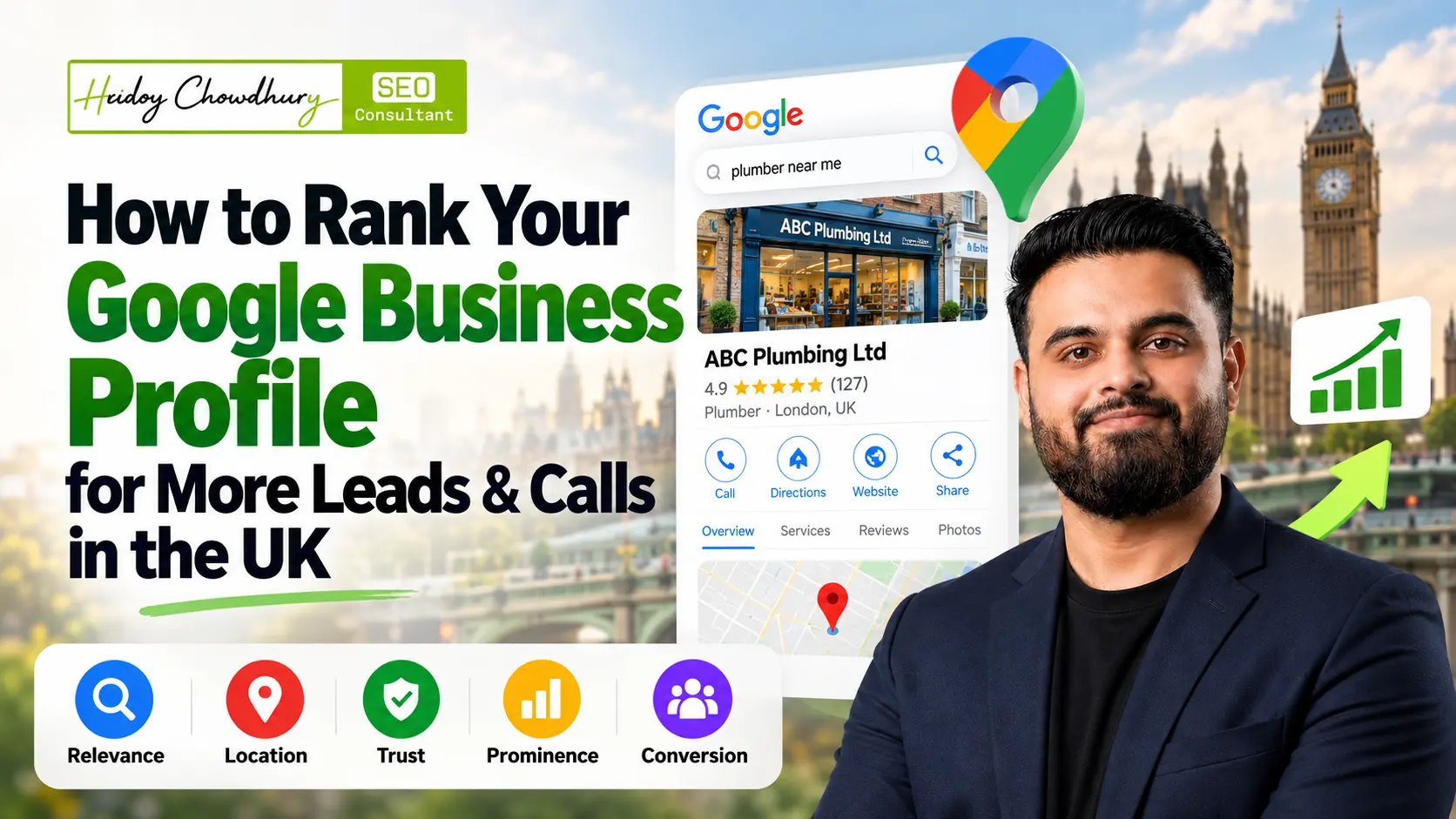
If you run a local business in the UK, your Google Business Profile should not simply exist.
It should help potential customers find your business, understand what you offer, trust you, visit your website, call you, request directions, and ultimately become customers.
I’m Hridoy Chowdhury, a London-based SEO Consultant with 7+ years of hands-on SEO experience. Across thousands of SEO projects, Local SEO has taught me an important lesson:
The goal isn’t simply to rank a Google Business Profile. The goal is to turn local search visibility into qualified enquiries, calls, bookings and customers.
That distinction changes how I approach Google Business Profile optimisation.
Google itself says local results are mainly determined by relevance, distance and prominence. Complete information, reviews, links and your wider organic-search presence can contribute to local visibility. Google Help
So if you want to improve your GBP rankings in the UK, I would focus on building a stronger local business entity and customer journey, rather than searching for a single Maps ranking trick.
My Approach to Google Business Profile SEO
When I work on Local SEO, I don’t look at the Google Business Profile in isolation.
I look at the relationship between your profile, website, services, location, reviews, local authority, competitors and the searches that actually generate business.
My process is built around five areas:
Relevance + Location + Trust + Prominence + Conversion
Google officially describes relevance, distance and prominence as its primary local ranking considerations.
The additional focus on trust and conversion is part of my own Local SEO methodology: ranking is useful, but a business ultimately needs customers.
Here’s how I approach it.
1. Make Sure Your GBP Is Eligible, Accurate and Verified
Before thinking about rankings, get the foundation right.
Your profile should accurately represent the real business.
Google says a Business Profile can represent a business that has a physical location customers can visit or one that travels to customers. It also recommends keeping information accurate and complete.
Check your:
- Business name
- Primary category
- Secondary categories
- Address or service area
- Telephone number
- Website
- Opening hours
- Services
- Attributes
One of the mistakes I see businesses make is trying to optimise incorrect information rather than fixing the underlying profile first.
You need a clean foundation before you build authority around it.
2. Don’t Keyword-Stuff Your Business Name
Imagine your actual company is called:
ABC Plumbing Ltd
Changing your GBP name to:
ABC Plumbing Ltd – Best Emergency Plumber London Boiler Repair
is not a Local SEO strategy.
Google says your profile name should reflect the business’s real-world name as it is consistently represented on signage, stationery, the website and other branding. Adding unnecessary information can violate Google’s guidelines and potentially lead to profile enforcement.
I prefer building relevance through legitimate signals rather than creating unnecessary suspension risk.
3. Your Primary GBP Category Matters
If I were auditing a poorly performing Google Business Profile, one of the first things I’d investigate would be its category configuration.
Google confirms that the categories selected can affect local ranking and recommends choosing the most specific primary category that accurately represents the business.
Think:
- What IS this business?
Not:
- What keywords would I like this business to rank for?
For example, depending on what the business actually is, a specialist category may describe it better than a broad category.
Then use additional categories only where they accurately represent genuine parts of the business.
More categories don’t automatically mean more rankings.
Accuracy and relevance come first.
4. Build Your GBP Around the Services That Generate Revenue
This is where strategy starts becoming commercial.
Suppose you operate a roofing company.
You might provide:
- Roof repair
- Flat roofing
- Emergency roof repair
- Gutter repair
- Roof replacement
- Chimney repair
I don’t want Google merely to understand that you’re a “roofing company.”
I want the overall search presence to make your genuine services clear.
Google notes that service information can also be drawn from a merchant’s service list, website and other authoritative sources in some service-business experiences.
That means your GBP and website should tell a consistent story about what the business actually provides.
5. Your Website and GBP Need to Work Together
This is one of the most important parts of my Local SEO approach.
GBP SEO is not separate from website SEO.
Google says it uses publicly available web information, including crawled content from official business websites, as one source for Business Profile information. Google also states that organic web ranking is relevant to local ranking.
If you’re trying to rank for:
Emergency Plumber London
but your website barely explains your emergency plumbing service, you have a wider relevance problem.
I would build the website around a clear architecture such as:
Homepage
↓
Plumbing Services
↓
Emergency Plumbing
Boiler Repair
Leak Detection
Bathroom Plumbing
↓
Relevant Location Pages
Your GBP then becomes part of a wider local-search ecosystem rather than an isolated listing.
6. Create Strong Service Pages
Don’t try to make your homepage rank for every service.
If a service is commercially important and has genuine search demand, consider giving it a dedicated page.
For example:
/emergency-plumber/
/boiler-repair/
/leak-detection/
/bathroom-plumbing/
Each page should clearly answer:
What is the service?
Who needs it?
What problems does it solve?
Where is it available?
What does the process involve?
Why should customers trust the company?
What should the customer do next?
This creates deeper topical relevance than repeating a keyword 20 times on the homepage.
7. Build Location Relevance Without Creating Doorway-Style Pages
Location pages can be extremely useful when done properly.
But this:
Plumber London
becomes:
Plumber Croydon
then:
Plumber Greenwich
then:
Plumber Bromley
with 95% identical content.
That’s not the strategy I recommend.
If you’re genuinely targeting a location, make the page useful for customers in that area.
Include appropriate local information, services available, genuine projects or experience where you have evidence, relevant FAQs and a strong conversion path.
The page should deserve to exist.
8. Reviews Are Part of Your Local Authority
Reviews matter for far more than making your star rating look attractive.
Google explicitly says review count and positive ratings can help local ranking. It also recommends responding to reviews.
But I don’t recommend approaching reviews as:
“We need 100 reviews because the competitor has 90.”
Build a review acquisition system.
For example:
Service completed → Customer satisfaction confirmed → Review request → Customer leaves genuine feedback → Business responds
You want authentic reviews from genuine customers over time.
That gives you something much more valuable than a temporary ranking tactic:
Trust.
9. Reply to Your Reviews Like a Human
Avoid responding to 100 reviews with:
Thank you for your review.
Your replies are public.
Potential customers can read them.
Use the opportunity to demonstrate that there is a real business behind the profile.
A natural response might be:
Thank you, David. I’m glad the team could get the boiler problem sorted quickly. We really appreciate you taking the time to share your experience.
You don’t need to stuff:
“best boiler repair company London”
into the response.
Write for the customer first.
10. Add Genuine Photos and Videos
Google recommends adding photos and videos to help customers understand what a business offers.
For a UK local service business, I would prioritize genuine visual evidence such as:
- Team members
- Premises
- Vehicles
- Equipment
- Work in progress
- Completed jobs
- Before-and-after examples where appropriate
- Products
- Customer-facing areas
Your photo gallery should make the business feel real.
A profile containing genuine business activity is more persuasive to potential customers than one containing only stock images and promotional graphics.
11. Get Your Service-Area Setup Right
This is particularly important for:
- Plumbers
- Electricians
- Roofers
- Cleaners
- Locksmiths
- Landscapers
- Mobile mechanics
- Pest-control companies
and other businesses that visit customers.
If you don’t serve customers at your business address, Google says the address should be removed from the public profile and the service area should be configured instead. Google currently allows up to 20 service areas and says the overall service area generally shouldn’t extend beyond roughly two hours’ driving time from the business base.
Don’t create fake offices around the UK to manufacture local rankings.
Google’s guidelines specifically restrict virtual offices unless they satisfy its actual-location requirements.
Short-term manipulation isn’t how I build Local SEO campaigns.
12. Build Consistent Business Information Across the Web
Google doesn’t learn about your business exclusively from what you type into GBP.
Its documentation says profile information can come from publicly available web content, licensed third-party data, user contributions and Google’s own interactions with places and businesses.
That makes wider business consistency important.
Depending on the company, I look at relevant:
- UK business directories
- Industry directories
- Professional associations
- Trade organisations
- Local chambers
- Supplier websites
- Local publications
- Trusted niche websites
But don’t interpret this as:
“Hridoy says I need 500 directory submissions.”
I don’t.
I would rather have fewer accurate, relevant and trustworthy references than hundreds of meaningless listings.
13. Build Local Backlinks and Brand Mentions
This is another area businesses often underestimate.
Google says prominence is influenced by information about a business from across the web, including links, and that organic web ranking also contributes to local results.
For a UK business, opportunities may come from:
- Local publications
- Industry organisations
- Community partnerships
- Suppliers
- Professional associations
- Local sponsorships
- Business partnerships
- Useful local resources
- Digital PR
The question I ask isn’t:
How many backlinks can we build?
It’s:
Which sources would make sense for a legitimate business in this industry and location to be mentioned by?
That’s a much better foundation for sustainable authority.
14. Understand the One GBP Factor You Cannot Fully Control
This is where I prefer being transparent with clients.
You can improve relevance.
You can improve prominence.
You can improve reviews.
You can improve the website.
You can improve authority.
You can improve conversion.
But you cannot completely control distance.
Google considers how far a potential result is from the searcher. If a user doesn’t specify a location, Google can calculate distance using what it knows about that user’s location.
That’s why GBP rankings can change dramatically depending on where the search is performed.
A business might perform strongly two miles away and much less strongly eight miles away.
This is also why I don’t judge Local SEO performance from a single manual Google search.
15. Track Local Rankings Geographically
If you’re optimizing a business across a city, you need to understand where visibility is strong and where it becomes weak.
A geographic local-ranking grid can help identify patterns.
For example, you might discover:
Near business location: Strong visibility
North of city: Moderate visibility
South-east: Weak visibility
Specific service keyword: Strong
Higher-value keyword: Weak
That gives you something actionable.
You can then investigate whether the problem relates to proximity, relevance, competition, website support, reviews, prominence or another factor.
16. Don’t Measure Success Only With Rankings
This is one of the biggest differences in how I think about Local SEO.
Imagine I get you from position 8 to position 3.
Sounds great.
But what happens if nobody calls?
For me, Local SEO should ultimately connect:
Local visibility → Profile engagement → Calls/Website visits → Enquiries → Customers → Revenue
That’s why I want to understand which queries and pages attract the right customers—not simply which keywords look impressive in a ranking report.
17. Optimize the Profile for Calls and Leads
Once people find the business, the GBP needs to convince them to take action.
Ask yourself:
Does the profile immediately explain what we do?
Are our opening hours correct?
Is the phone number working?
Does the website landing page match the searcher’s intent?
Do our reviews inspire confidence?
Are there enough genuine photos?
Can someone quickly understand our services?
Is there a clear next step?
Ranking without conversion is wasted visibility.
18. Don’t Ignore Organic SEO
One of the most persistent Local SEO misconceptions is:
“I only need my Google Business Profile.”
Google itself says your position in web results is a factor in local ranking and recommends applying SEO best practices.
That’s why my Local SEO work looks beyond GBP.
I consider:
- Technical SEO
- On-page SEO
- Service pages
- Location pages
- Internal linking
- Local content
- Structured data
- Backlinks
- Brand mentions
- Reviews
- Entity consistency
- Google Business Profile
Together, these create a much stronger local-search presence.
19. Avoid GBP Shortcuts That Can Put the Business at Risk
Some tactics can look attractive because competitors may appear to be getting away with them.
I wouldn’t build a client’s long-term local visibility around them.
Be especially careful with:
- Fake locations
- Virtual offices that don’t qualify
- Keyword-stuffed business names
- Duplicate profiles
- Fake reviews
- Irrelevant categories
- Incorrect addresses
- Misleading business information
Google requires businesses to represent themselves accurately and warns that policy violations can lead to restrictions or profiles being disabled.
My philosophy is simple:
Build an asset, not a liability.
My Google Business Profile Ranking Framework for UK Businesses
After working across SEO projects for more than seven years, I don’t believe GBP optimisation should be reduced to “fill in your profile and get reviews.”
My framework has four stages.
Stage 1 — Foundation
Get the profile verified, eligible, accurate and complete. Fix the business name, category, location/service area, hours, services and core information.
Stage 2 — Relevance
Build clear relationships between the services people search for, your GBP, website architecture, service pages and genuine locations.
Stage 3 — Prominence & Trust
Strengthen reviews, website authority, local links, business citations, third-party mentions, genuine photos and broader brand signals.
Stage 4 — Leads & Revenue
Measure what happens after visibility improves: calls, forms, bookings, enquiries, customers and commercial outcomes.
This is why I don’t sell Local SEO as simply:
“I’ll rank your GBP.”
I approach it as:
How do we make your business more visible when the right local customer searches—and turn that visibility into an enquiry?
That is a much more useful business question.
Why Work With Hridoy Chowdhury for Google Business Profile & Local SEO?
I’m Hridoy Chowdhury, a London-based SEO Consultant with 7+ years of hands-on experience and 3,500+ completed SEO projects.
I’m also a Top Rated Plus professional on Upwork with a 98% Job Success Rate, and I’ve trained more than 50,000 learners through my SEO and freelancing education.
My Local SEO work isn’t separated from the rest of search.
I look at the complete picture: your Google Business Profile, website, technical SEO, services, local landing pages, search intent, reviews, competitors, backlinks, brand authority and conversion journey.
And as search evolves, I also consider how clear business information, expert content, entity understanding and third-party authority can strengthen a company’s discoverability beyond traditional search, including emerging AI-assisted search experiences.
I don’t promise #1 rankings.
I don’t promise that I can manipulate Google’s algorithm.
And I won’t tell you that changing one GBP setting will suddenly generate hundreds of calls.
What I can bring is experience, evidence-led analysis, clear prioritisation and an SEO strategy built around business outcomes rather than vanity metrics.
That’s how I believe Local SEO consultancy should work.
Frequently Asked Questions
How do I rank my Google Business Profile higher in the UK?
Start with an accurate, verified and complete profile. Select the correct primary category, add genuine services, maintain accurate opening hours, earn legitimate customer reviews, build a strong local website and develop relevant authority around your business. Google says local results are primarily determined by relevance, distance and prominence.
How long does Google Business Profile SEO take?
There is no universal timeframe. Competition, location, proximity, existing authority, website strength, reviews, business category and the starting condition of the profile can all affect progress. Google also notes that rankings for new businesses can take up to a month to appear in search results.
Do reviews help Google Maps rankings?
Google states that review count and positive ratings can contribute to local ranking. Reviews are also important for customer trust and conversion.
Can I rank my GBP across the whole of London?
Visibility can vary considerably because distance is one of Google’s core local-ranking considerations. Your ability to rank consistently across a large geographic area will therefore depend partly on where the searcher is located, alongside relevance and prominence.
Should I add keywords to my GBP business name?
Only when they are genuinely part of the real-world business name. Google’s guidelines prohibit adding unnecessary information to the Business Profile name.
Can I use a virtual office to rank in another UK city?
A virtual office is not eligible simply because you rent an address there. Google’s rules require eligible locations to meet specific real-world operating conditions.
Can Hridoy Chowdhury help optimise my Google Business Profile?
Yes. My approach covers the GBP itself as well as the wider Local SEO environment around it: categories, services, website optimisation, location relevance, reviews, competitors, citations, backlinks, technical SEO and conversion opportunities.
Want More Calls and Leads From Google Maps?
If your Google Business Profile isn’t generating enough visibility, calls or qualified enquiries, the first step isn’t blindly making more edits.
Find out why.
I can review your Google Business Profile, website, local competitors and wider search presence to identify where your biggest opportunities are.
Book a Local SEO & Google Business Profile Consultation with Hridoy Chowdhury.
The objective isn’t simply to make your profile “look optimized.”
It’s to build a stronger local search presence that helps the right customers find your business and gives them a reason to contact you.