
- GEO Strategy 2026
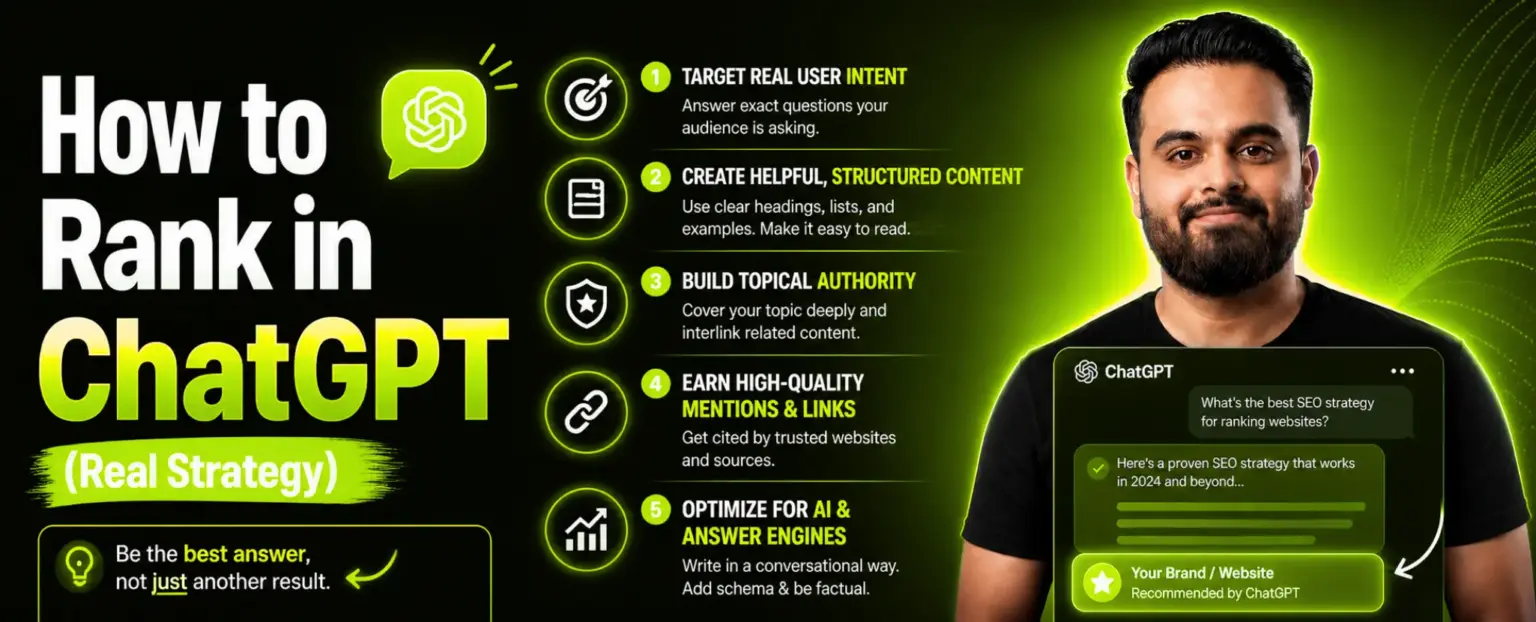
How to Rank in ChatGPT: The Real GEO Strategy That Actually Works
Most SEOs are optimising for Google. The brands winning right now are optimising for AI. Here’s the exact strategy I use across 3,500+ projects.
Table of Contents
I’ve been doing SEO for over 7 years. 3,500+ projects. 50,000+ students. 98% Job Success Rate on Upwork as a Top Rated Plus freelancer.
And right now — the biggest shift I’m seeing in search has nothing to do with a Google algorithm update.
It’s this:
People are typing their problems into ChatGPT instead of Google. And the brands that show up inside those AI responses? They are winning deals, clients, and customers that Google-only strategies will never capture.
This isn’t theory. It’s happening right now. And most SEOs are completely unprepared for it.
In this pillar guide, I’ll walk you through exactly what Generative Engine Optimisation (GEO) is, why it matters more than most people realise, and the complete step-by-step strategy I use to help clients rank inside ChatGPT — with real results to back it up.
What Is GEO (Generative Engine Optimisation)?
GEO stands for Generative Engine Optimisation. It is the practice of optimising your brand, content, and online presence so that AI-powered tools — like ChatGPT, Google Gemini, Claude, and Perplexity — recommend and cite you in their generated responses.
Traditional SEO gets you ranked in Google’s blue links. GEO gets you cited inside AI-generated answers. These are two completely different games. But the brands playing both right now are capturing more visibility than anyone else.
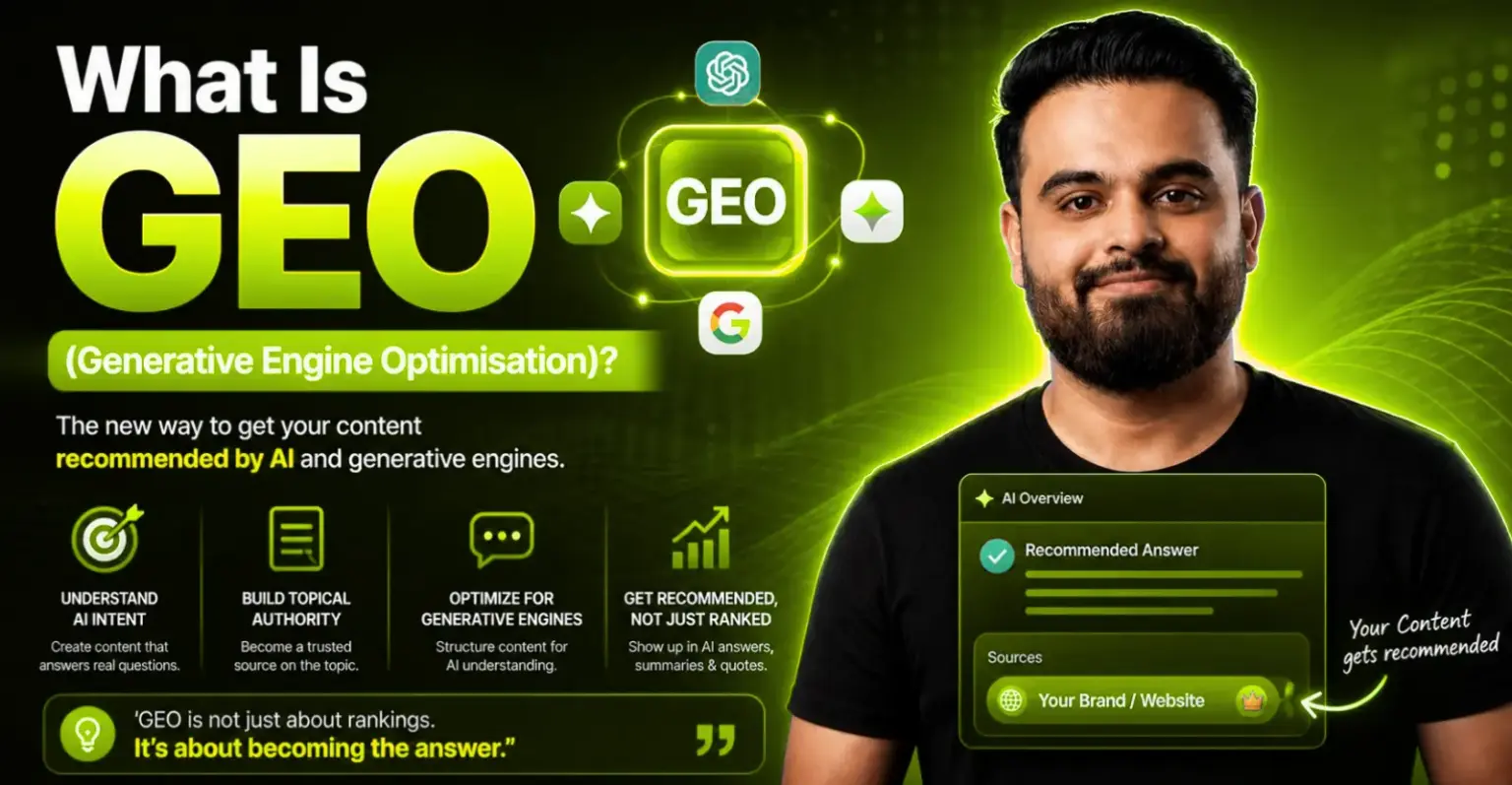
Key distinction: GEO is sometimes called AEO (Answer Engine Optimisation). Both terms describe the same objective — optimising for AI systems that generate answers rather than lists of links. I use GEO because it’s more precise: we’re optimising for generative models specifically.
Why AI Search Is Growing Faster Than Anyone Expected
ChatGPT surpassed 100 million weekly active users faster than any consumer application in history. Perplexity is growing at a pace that concerns Google’s leadership. Microsoft has embedded AI into Bing. Google has rolled out AI Overviews into mainstream search results.
The shift from “find links” to “get answers” is not a future trend. It is the present reality. And every month you delay building your GEO presence is a month your competitors use to establish theirs.
Why ChatGPT Rankings Matter More Than You Think
Here is the thing most people miss about how ChatGPT actually works. It doesn’t generate content from thin air. It draws from:
- Vast training data — billions of web pages, books, and online discussions
- Real-time web browsing when GPT-4o search mode is enabled
- Cited sources from authoritative websites it has indexed
- Entity knowledge — how clearly and consistently your brand is defined across the web
If your brand doesn’t exist clearly in those places, ChatGPT simply won’t mention you. It will mention your competitors instead.
I’ve seen this pattern repeat across dozens of client industries — lawyers, accountants, SaaS founders, e-commerce brands. They had solid Google rankings. But when their prospects typed questions into ChatGPT, a competitor kept appearing in the response.
The uncomfortable truth: If someone types “who is the best SEO expert in London” into ChatGPT and your name doesn’t appear — a competitor is capturing that trust signal at the exact moment it matters most. GEO is how you fix that.
Traditional SEO vs GEO: What’s Different?
I want to be direct about this: GEO does not replace SEO. It extends it. The fundamentals of technical SEO, content quality, backlinks, and user experience all still matter. But GEO adds new dimensions that traditional SEO doesn’t address.
| Signal | Traditional SEO | GEO (AI Optimisation) |
|---|---|---|
| Primary target | Google algorithm | AI training data + entity recognition |
| Content goal | Rank for keywords | Become the answer to a question |
| Link building | Backlinks for PageRank | Citations from authoritative sources |
| Brand presence | Domain authority | Entity clarity (who you are, everywhere) |
| Structured data | Rich snippets | AI context signals (FAQ, HowTo, Person) |
| Forum/community | Nofollow links (weak signal) | High-value GEO signal (Reddit, Quora) |
| Tracking | Google Search Console, rank trackers | Manual AI prompt monitoring (tools emerging) |
The smartest SEO strategy in 2025 integrates both. Run traditional SEO to capture Google traffic. Build GEO to capture the growing share of intent that flows through AI responses.
The 7-Step Strategy to Rank in ChatGPT
Here is exactly what I do for clients. These are methods I have tested and refined across 4,000+ SEO projects. Not theory. Not speculation. Real strategy with measurable outcomes.
01
Build Your Entity Across the Web
ChatGPT builds a picture of who you are based on what the internet says about you consistently and authoritatively. If that picture is weak, blurry, or contradictory — you will not get cited.
What to do: Make your entity undeniable. ChatGPT should have zero doubt about who you are, what you do, and why you are trustworthy.
- Claim and complete a Wikipedia or Wikidata entry (if applicable)
- Optimise your LinkedIn profile with precise positioning, credentials, and keywords
- Create or update your Crunchbase, About.me, and industry directory profiles
- Ensure your website's About page, author bio, and Person schema are complete and consistent
- Use the exact same name, title, location, and credentials on every platform
02
Create Answer-Shaped Content
Most websites publish content written for Google’s keyword algorithm. ChatGPT doesn’t care about keyword density. It cares about whether your content directly and completely answers a specific question.
- Structure every article with the question in the H1 or H2 and the direct answer in the first paragraph
- Write for question formats: "What is X", "How does Y work", "Best Z for [situation]"
- Add a dedicated FAQ section to every pillar page
- Keep paragraphs short — AI systems favour scannable, structured content
- Use numbered lists and structured subheadings throughout
03
Earn Citations From Authoritative Sources
ChatGPT weights content from trusted, authoritative websites heavily. If Forbes mentions you, if a respected niche publication references your research, if a podcast host cites your framework — ChatGPT pays attention. Think of these citations as the backlinks of GEO.
- Publish original research and data that other writers will naturally reference
- Contribute guest articles to high-authority publications in your niche
- Use HARO (Help A Reporter Out) to earn press mentions from journalists
- Build relationships with podcast hosts and newsletter writers who cite sources
- Create quotable statistics and findings that reporters can link to directly
04
Dominate Reddit, Quora, and Forums
This surprises most people. But it’s one of the most powerful GEO signals available right now — and one of the least competitive.
- Build a genuine expert presence in subreddits relevant to your industry
- Answer questions thoroughly on Quora — full answers, not partial teasers
- Participate in niche forums and communities where your audience gathers
- Reference your brand naturally when genuinely relevant — never spam
- Aim to be the expert voice in discussions, not just a link-dropper
05
Implement Structured Data (Schema Markup)
Schema markup helps AI systems understand what your content is about — not just what words appear on the page. For GEO, this is foundational, not optional.
- FAQ Schema — marks your Q&A content as direct answers to specific questions
- HowTo Schema — signals instructional, step-by-step content to AI systems
- Article Schema — identifies you as the author and establishes topical expertise
- Person Schema — defines you as a named expert entity with verifiable credentials
- Organisation Schema — defines your brand, location, services, and founding date clearly
06
Publish Consistently on LinkedIn
LinkedIn is indexed by Google and cited more by AI systems than most SEOs realise. Consistent, expert-led posts serve two GEO functions simultaneously: they build your entity signal and they create indexed, citable content.
- Post at minimum 3–5 times per week with genuine expert insight
- Share specific data points, frameworks, and case-study findings — not generic advice
- Write in a format AI can parse: short sentences, clear structures, direct conclusions
- Include your location and specialty consistently in your profile and posts
- Engage genuinely in comments — activity signals credibility to platform algorithms and AI systems alike
07
Build Your Email List and Owned Audience
Here is where GEO and long-term business strategy converge. The brands that rank consistently in ChatGPT are not just optimising content — they are building real audiences who generate authentic online presence signals that AI systems trust.
- Build an email list as your foundation — it's the only audience you truly own
- Encourage subscribers to share content, leave reviews, and mention your brand online
- Create a community around your expertise — Discord, Slack, or newsletter community
- When your audience writes about you on their blogs and social media, those citations multiply your GEO footprint organically
What Does Ranking in ChatGPT Actually Look Like?
Let me be precise about what we are optimising for. When someone types a question into ChatGPT, the AI generates a response. Within that response, it may:
- Name your brand as a recommended tool, service, or agency
- Cite your website as a credible source with a direct link
- Quote your original data, research, or framework
- Name you personally as an expert to follow or consult
- Reference your published work as evidence for a claim it is making
All of these are measurable wins. And they are all achievable with a consistent GEO strategy.
For clients in the London SEO, legal, and SaaS spaces, I track ChatGPT visibility by running regular, targeted prompts relevant to their industry and documenting how frequently and positively they appear in the responses. Right now, this monitoring is largely manual — but dedicated GEO tracking tools are emerging rapidly, and the brands building this presence today will have a compounding head start when those tools become mainstream.
See real GEO and SEO results from client projects
Documented case studies across SEO, GEO, and content strategy — with real traffic and ranking data.
Schema Markup Guide for GEO: What to Implement and Where
Schema markup is often treated as a nice-to-have SEO feature. For GEO, it is mission-critical. Here is a practical breakdown of which schema types to prioritise and where to place them on your website.
Person Schema – Your Most Important GEO Asset
If you are a consultant, expert, or personal brand, Person schema is the single most impactful GEO implementation you can make. It tells AI systems exactly who you are, what you do, where you are based, and where to find authoritative information about you.
FAQ Schema – Direct Answer Injection
FAQ schema is the closest thing to a direct pipeline into AI-generated answers. When your FAQ content is marked up with schema and indexed, AI systems can pull those precise question-and-answer pairs directly into their responses.
Every pillar page, service page, and key blog post on your site should include a FAQ section with a minimum of 5 questions — all marked up with FAQ schema.
HowTo Schema – Step-by-Step Authority
For any instructional or process-oriented content, HowTo schema signals to AI systems that your page contains a structured, expert-led methodology. This article itself, for example, would use HowTo schema for the 7-step GEO strategy section.
Article + Author Schema – Establishing E-E-A-T
Google’s E-E-A-T (Experience, Expertise, Authoritativeness, Trustworthiness) guidelines apply directly to AI citation decisions. Article schema with a clearly defined Author entity tells AI systems that a real, credentialed expert wrote this content — which is a significant trust signal.
Real Results: What GEO Has Done for My Clients
I don’t write about strategies I haven’t tested. Over the past 12 months, I’ve been implementing GEO principles for clients across multiple sectors — SaaS platforms, legal practices, e-commerce brands, and professional services firms in London and internationally.
Patterns I’m consistently seeing:
- Clients with strong entity optimisation appear in ChatGPT recommendations for branded queries within 60–90 days of implementation
- Answer-shaped content pages are cited in Perplexity responses at a significantly higher rate than standard blog posts
- Clients who build genuine presence in relevant Reddit communities appear in ChatGPT recommendations for non-branded industry queries
- Schema-rich pages — particularly those with FAQ and Person schema — consistently outperform non-schema pages in AI citation frequency
- Clients who invest in original data and research earn more AI citations per published piece than those producing derivative content
Detailed case studies with real data
Read documented client outcomes — traffic growth, AI visibility improvements, and ranking results.
Frequently Asked Questions About Ranking in ChatGPT
These are the questions I get asked most often by clients, students, and LinkedIn followers. I’ve answered each one directly based on real project experience.
Can you actually rank in ChatGPT?
Yes — though it works differently from ranking on Google. ChatGPT doesn’t have a traditional SERP with position 1, 2, 3. But it does recommend brands, cite sources by name, and identify experts in its responses. Generative Engine Optimisation is the practice of making your brand, content, and entity the one that gets cited. Based on client results across 4,000+ projects, this is measurable, achievable, and increasingly important for any business that relies on search-driven discovery.
How long does it take to appear in ChatGPT responses?
Based on my client work, entity-level visibility improvements typically take 60 to 90 days of consistent GEO effort to become noticeable. Citation appearances can happen faster — within 30 days in some cases — if you earn mentions from highly authoritative sources quickly. The timeline depends heavily on how competitive your niche is and how strong your existing online presence is.
What is the difference between GEO and AEO?
GEO (Generative Engine Optimisation) and AEO (Answer Engine Optimisation) are used interchangeably by most practitioners. Both describe the practice of optimising your content and presence for AI-powered answer systems. I prefer GEO because it is more specific — it refers to generative AI models like ChatGPT, whereas AEO can also refer to older featured-snippet optimisation. In practice, both terms describe the same set of strategies.
Does traditional SEO help with ChatGPT rankings?
Absolutely. Strong technical SEO, high-quality backlinks, and authoritative content all contribute positively to GEO performance. ChatGPT’s training data includes the indexed web — pages that perform well on Google tend to carry authority in AI training datasets too. I recommend running both SEO and GEO simultaneously, as most of the activities overlap: quality content, authoritative links, structured data, and strong entity presence benefit both strategies.
What is the single most important GEO signal?
Entity clarity. If ChatGPT cannot clearly identify who you are, what you do, and why you are credible — based on consistent, authoritative information across multiple trusted platforms — it will not cite or recommend you. Before you invest in content, citations, or schema, ensure your entity is defined clearly and consistently everywhere: your website, LinkedIn, Wikidata, Crunchbase, and any other authority platform relevant to your industry.
How do I optimise my blog content specifically for ChatGPT?
Write answer-shaped content. Structure every article around a specific question in the H1 or H2 and answer it directly in the first paragraph. Use numbered and bulleted lists throughout. Add a FAQ section at the end of every pillar page with minimum 5 questions, all marked up with FAQ schema. Keep paragraphs short and avoid filler content — AI systems favour clear, structured, specific answers over lengthy narrative prose.
Why does Reddit matter for ranking in ChatGPT?
ChatGPT was trained heavily on Reddit data. Real community discussions, authentic expert opinions, and genuine brand recommendations on Reddit carry significant weight in AI training datasets. If your brand, name, or expertise is referenced positively in relevant subreddit discussions, ChatGPT is far more likely to surface you in responses about your industry. Build a genuine, expert presence in relevant communities — not a promotional one.
Should I stop doing SEO and focus only on GEO?
No. GEO extends traditional SEO — it does not replace it. Google still processes over 8.5 billion searches daily. SEO continues to deliver significant, measurable traffic. The most effective strategy in 2025 is running both simultaneously. Most GEO activities — content quality, authoritative backlinks, technical site health, structured data — also benefit traditional SEO. The two strategies are complementary, not competing.
Final Thoughts: The Shift Is Already Happening
SEO has been declared dead many times over the past decade. Voice search was going to kill it. Social media was going to replace it. ChatGPT was going to make Google irrelevant.
None of those things killed search. But each one changed it.
GEO isn’t the end of SEO. It’s the next evolution. And the brands I see winning right now aren’t waiting to see what happens — they’re building their entity, publishing answer-shaped content, earning authoritative citations, and establishing their presence in the places AI systems draw from.
I’ve spent 7 years and 4,000+ projects learning what works in search. I’ve trained 50,000+ students. I’ve watched every major algorithm shift since 2019. And I can tell you with confidence: this is the most significant strategic opportunity in organic marketing right now.

Hridoy Chowdhury
SEO Expert London · Top Rated Plus, Upwork
I started my SEO career in London and have since completed 3,500+ projects for clients across SaaS, legal, e-commerce, and professional services. I’m a Top Rated Plus freelancer on Upwork with a 98% Job Success Rate, and I’ve trained over 50,000 students in SEO through my YouTube channel and courses.
I write and teach about the strategies that actually work — not the ones that sound good in blog posts. GEO is the biggest shift I’ve seen in search since mobile-first indexing, and I’m documenting everything in real time.
Ready to Rank in ChatGPT?
See the exact GEO strategies I’ve implemented for real clients — with traffic data, AI visibility results, and step-by-step documentation.